


British Empire Exhibition
After World War I, the British Empire was at its greatest extent. The British Empire Exhibition, held at Wembley near London in 1924, aimed to celebrate its diversity. All the Dominions, India and groups of smaller colonies built pavilions on a 216 acre site. Huge concrete Palaces of Engineering and Industry were erected.
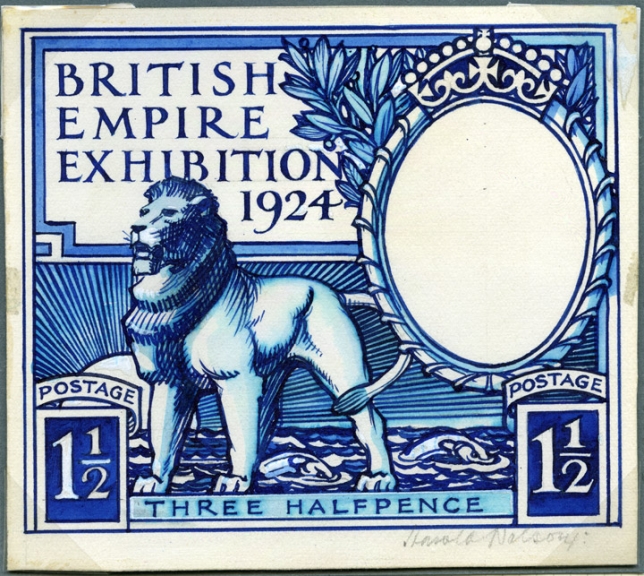
The Exhibition was also the occasion for Britain's first commemorative stamps. The chosen design depicted a lion in an imposing stance – symbolic of Britain's power. The pair of large format stamps were issued in 1924 and again in 1925.
Within the Exhibition, the Post Office had a gallery in the Government Pavilion and displayed the latest communications technology. This included a working model of the Post Office's Underground Railway, then under construction in London.
The Exhibition was opened on 23 April 1924 by King George V. Between April and its close in November it received over 17 million visitors. Having proved so popular, it re-opened for a similar period in 1925.
British Empire Exhibition commemorative stamp: accepted design
(below left) When the King agreed to a special stamp issue, a Committee was set up to obtain designs. One by Eric Gill was chosen, but the King preferred the lion image by Harold Nelson.
More on the British Empire Exhibition stamps
Map of the Exhibition grounds, reverse, 1924
(below centre) A special Exhibition railway station was constructed to improve access for visitors. It was linked to Marylebone Station in central London.
While most of the Exhibition was designed to be temporary, some of the larger concrete structures survived. The Empire Stadium was renamed Wembley Stadium and was in use until 2000.
Lent by Dr Jean Alexander
The Indian Pavilion
(below right) A postcard showing the Indian Pavilion.
- Illustrations

British Empire Exhibition design
Map of the Exhibition grounds
The Indian Pavilion


You may also be interested in...
Empire Mail postcards

Featuring items from the Empire Mail exhibition
Postcards featuring artwork for posters, stamps and greetings telegrams, as seen in Empire Mail: George V and the GPO.
George V stamps

Explore our collection of stamps from the reign of George V
The reign of George V saw many firsts for British stamps, including the first commemorative stamp issues.
Postal History of India

The postal history of India is closely tied to India's complex political history
Britain's involvement in the Indian postal service began in the 18th century, and continued until Independence.


