


Stamp printing & perforations
The first stamps were cut individually from each sheet using scissors. The original form of stamp printing was recess, or intaglio. The paper was wetted during this printing process, and when the paper dried it shrank. This made it very difficult to achieve precise spacing between the labels on a sheet, which hampered mechanical separation.
Between 1847 and 1850 Henry Archer had been developing a machine that would punch out perforation holes to separate individuals stamps on a sheet. Archer advocated printing the stamps by letterpress, a dry printing process, avoiding the spacing problems caused by intaglio printing.
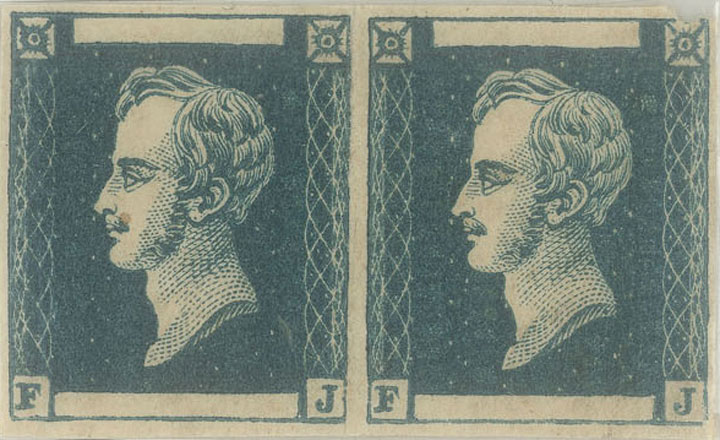
In April 1851 Archer worked with Robert Branston, a well-known wood-engraver, to produce an essay based on the Penny Black but with the portrait of Albert, the Prince Consort. This stamp was printed letterpress and perforated on Archer's machine.
Although Archer and Branston failed to get the Treasury stamp contract they craved, letterpress printing came to be the standard Victorian technique for all stamp printing. The Prince Consort essay shown here can be regarded as the forerunner of later Victorian stamps.
- Illustration

Branston and Archer's essay
You may also be interested in...
George V and the GPO
Stamps, conflict and creativity examined in Douglas Muir's latest book
This book illustrates the postal history of George V's reign, including innovations in transport and art & design.
Stamp Design
Ever wondered how British stamps are designed?
Read our overview of how topics for stamps are chosen, and how stamps are designed and approved for printing.


