


Envelope-making machines
Envelopes, or covers, were not a British innovation. They were well known on the continent, originating in Northern Italy, possibly used even earlier in the Ottoman Empire. Initially, envelopes were all hand-made and sealed with wax, much like a lettersheet. Gumming was first suggested in late 1840.
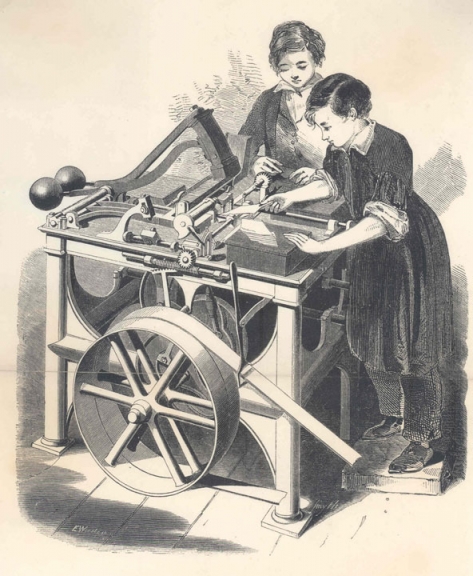
Rowland Hill's brother Edwin, who oversaw postage stamp production, invented a prototype envelope-folding machine. Warren De La Rue patented various developments of this, and the resulting machine was demonstrated at the Great Exhibition of 1851. The exhibition catalogue stated:
"This machine works at the rate of 2,700 envelopes per hour, and although superseding hand labour in folding, it is satisfactory to find that, instead of displacing hands, its introduction, by extending the consumption, has, in reality, created work for more than it has displaced".
By 1851 De La Rue had 11 machines at work.
- Illustration

The envelope-making machine
You may also be interested in...
Edward VIII stamps

Essays, artwork, drawings and issued stamps
Only four postage stamps were issued during Edward VIII's reign. Our collection contains a wealth of material.
Mechanised Sorting

A great many letters today are sorted mechanically
This page gives an overview of some of the most important mechanical sorting machines in our collection.
Victorian cover

Limited edition Victorian Innovation commemorative cover
Cover features an illustration of an envelope-making machine, and is serviced with a special single-date handstamp.


