


The volume of Valentine cards
Several cities and towns had a local Penny Post at the beginning of the nineteenth century. This meant that a letter could be delivered within a certain radius for the price of one penny.
Valentine cards could be cheaply sent in this way, and were sent in large numbers. Francis Freeling, the Secretary of the Post Office, wrote to the Postmaster General on 11 February 1835. He highlighted the need to make sure that the increased volume of post did not cause disruption.
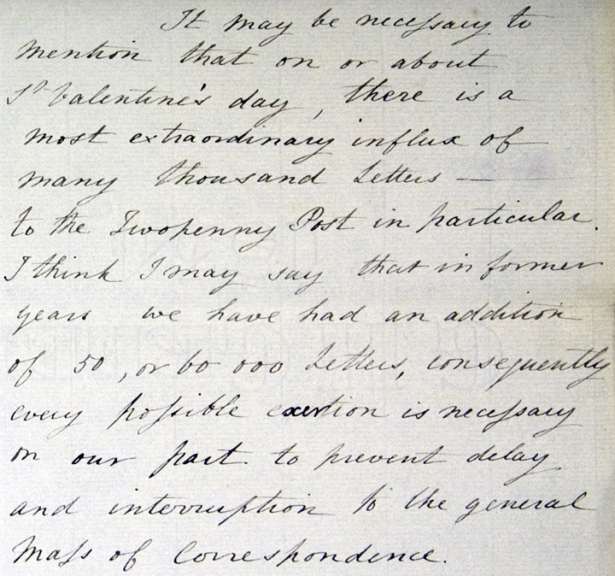
Part of his letter (pictured below left) reads:
'It may be necessary to mention that on or about St. Valentine's Day, there is a most extraordinary influx of many thousand letters – to the Twopenny post in particular…even former years we have had an addition of 50, or 60,000 Letters, consequently every possible exertion is necessary on our part to prevent delay and interruption to the general Mass of correspondence. […]'
- POST 40/615 - Reports to the Postmaster General No 77
Special Measures
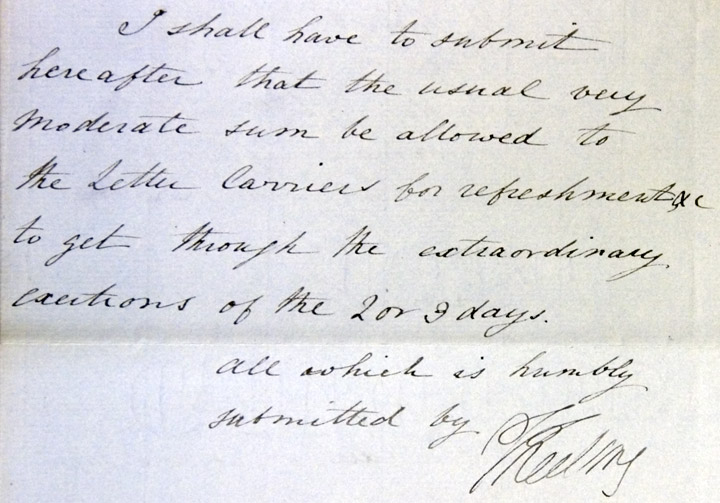
The Post Office felt the need to consider the poor Letter Carriers as a result of the large number of Valentines being sent. Francis Freeling's letter continued (pictured below right):
'I shall have to submit hereafter that the usual very moderate sum be allowed to the Letter Carriers for refreshments, etc. to get through the extraordinary exertions of the 2 or 3 days...'
- POST 40/615 - Reports to the Postmaster General No 77
- Illustrations

Extract #1 from Francis Freeling's letter
Extract #2 from Francis Freeling's letter
You may also be interested in...
Notable Individuals
Items relating to key individuals from the history of the Post Office
Including Anthony Trollope's signature stamp and material related to postal reformer Rowland Hill.


