


The Secret Room
During the Civil War agents of the Royal Mail were put to use in gathering intelligence. This episode of The People's Post explained how a network of loyal postmasters enabled those in power to intercept correspondence and limit their enemies' ability to communicate over distance. Although the Post Office today has a reputation for being a progressive force in British history, in its earliest days it was important not as a public service but as an organisation used for state surveillance and control.
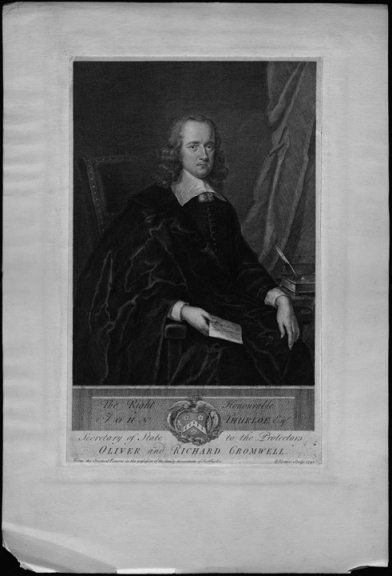
When Oliver Cromwell became Lord Protector of the Realm he turned to the Postmaster general, John Thurloe, for information about his enemies. Thurloe in effect became his "Spymaster General", commanding a network of postmasters who intercepted mail on his behalf, bringing news of intrigues and plots to his attention. This is unsurprising insofar as the interception of letters was in fact one of the reasons cited for establishing a public mail service upon its founding in 1635. Then, the merchant Thomas Witherings had persuaded King Charles I that the surveillance of correspondence would be a desirable by-product of the more efficient communications system he envisioned once the mails were opened up to the public.
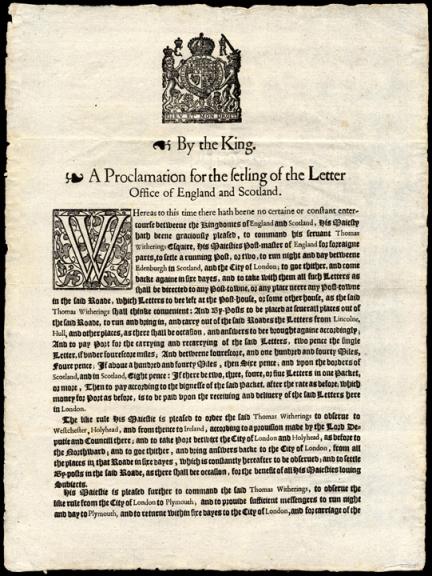
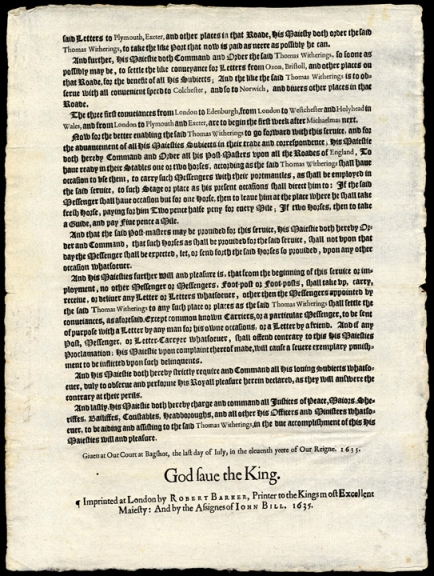
Having established mail routes to Europe in the 1620s, Witherings drew up a proposition in 1635 for a national system centred on London from which portmanteaux would travel to the towns filled with sealed bags of mail. A proclamation "For settling of the letter Office of England and Scotland" was issued on 31 July 1635 giving Witherings a monopoly on the carriage of letters. His couriers paid the posts 2½d per mile to use a horse, and postmasters were prohibited from hiring out horses on days when mail delivery was scheduled. According to his instructions, every postmaster was to "provide two leather bags lined with cotton or bayes", packets had labels inscribed with the time of receipt, and "hornes" were sounded four times every mile.
Once put into effect these arrangements enabled some 26,000 letters to be carried between London and the post towns every week.
Further Reading
Records held at The British Postal Museum & Archive provide glimpses of how this early organisation was managed and how a network of postmasters was paid, disciplined and organised: vital to the surveillance for which the mails came to be used. See the earliest records in classes POST 1 and POST 94 at the Royal Mail Archive. For a broader history of the early Royal Mail see Philip Beale, A History of the Post in England: from the Romans to the Stuarts (1998). Adrian Steel's blog on John Thurloe and the Secret Room gives further information on this topic.
- Illustrations

The Right Hon. John Thurloe Esq.
1635 Proclamation (1 of 2)
1635 Proclamation (2 of 2)
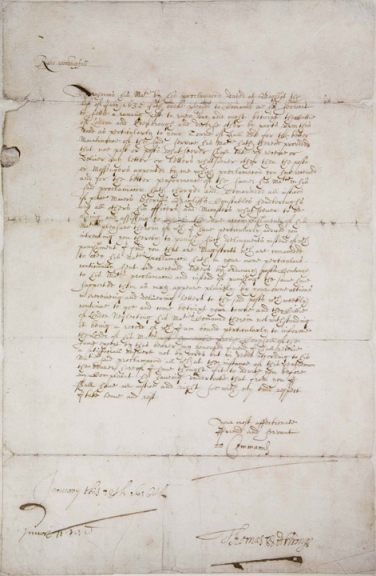
Letter from Thomas Witherings
You may also be interested in...
Masters of the Post

Duncan Campbell-Smith's authorised history of the Royal Mail
The first complete history of the Royal Mail — how it was built, how it led the world, and how it survived.
Post Office Leaders

Download lists of Post Office executives from the 17th century onwards
Postmasters General, Secretaries to the Post Office, Chairman and Chief Executive Officers of the Post Office.
Tours of the Archive

Let our archivists guide you through more than 400 years of history
Our free tours offer a fascinating behind the scenes look at our archive, which fills more than 2.5 miles of shelving.


