


Postal mechanisation
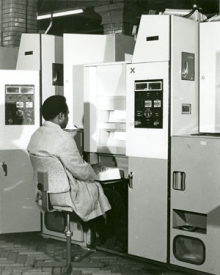
Postal worker sat in front of a new electronic coding desk, 1970s

Postal worker using a coding machine
To allow for mechanised sorting, a national postcoding system was required. Postal coding had been around in London since the mid 19th century, but it had not been applied in a uniform way across the country.
To speed up mail delivery in Victorian London, Sir Rowland Hill proposed dividing the capital into 10 separate postal districts. The districts would be denoted by the compass points, and an office established for each district. The original 10 districts - EC (Eastern Central), WC (Western Central), and then NW, N, NE, E, SE, S, SW, and W - were contained within a circle of 12 miles radius from central London. Hill’s plan was implemented during 1857 and 1858. In the 1860s London was followed by other large towns.
Modern postcodes were first trialled in Norwich in 1959. The version of postcodes that we know today was introduced in Croydon in 1966. Coding the entire country was done in stages, and finished in 1974 with the recoding of Norwich.
Postcoding, as intended, drove further postal mechanisation: from 1979 the first fully automatic sorting machines were introduced. The Mount officially became a Mechanised Letter Office (MLO) and it was here that the Post Office began trialling Optical Character Recognition (OCR). OCR reads printed addresses and the machine converts the postcode into a series of phosphor dots which it prints onto the envelope. This allows the sorting machine to 'read' each address automatically from the phosphor dots.

You may also be interested in...
Post Office in Pictures

A showcase of iconic images from The Royal Mail Archive
An exhibition which was inspired by promotional images produced by the General Post Office in the 1930s.
Posters Greetings Cards

Classic GPO posters from our collection on high quality Greetings Cards
The cards feature posters designed by Tom Eckersley, Hans Unger, George Him and Jan Lewitt, and Leonard Beaumont.


