


Stamps, Coins and Banknotes 1952- 2012
Portrayed on the definitive stamps of the commemorative miniature sheet, issued 6 February 2012, are some of the iconic portraits which have featured on the stamps, coins and banknotes of the Queen's reign.
The stamps of Great Britain are uniquely represented by the monarch's image. All other countries in the world must state the name of the country on their stamps. On Bank of England banknotes the use of the monarch's head is much more recent, dating from 1960.
When HM Queen Elizabeth II acceded to the throne, she was required to sit for a portrait that would form the basis of stamps and coins. On the 26th February 1952 Dorothy Wilding took these first portraits for both coins and stamps and Edmund Dulac was commissioned to create a drawn portrait as an alternative.
Dulac's frame artwork (with his portrait of the Queen with a tiara - and with the diadem/coronet bought forward as requested by the Queen), was then accepted for the stamp denominations of 1s to 1s 6d. This image formed the basis of the first of the Diamond Jubilee definitives.
For the coin effigies full profile images of the Queen were supplied to a number of artists. The chosen artist was Mary Gillick who had created a plaster cast without either tiara or diadem. Gillick's version was selected and first used for coins in 1953. The image is still used on Maundy money today and has been chosen for use on the new stamps.
It was not until 1960 that Bank of England notes bore the monarch's head. The first two notes for a new design series C, were designed by Robert Austin, consultant note designer at the bank. In 1971, a new series of notes, D, designed by Harry Eccleston, began to appear.
As early as 1962 work began on new designs for the forthcoming decimal coinage. Lord Snowdon took a series of photographs of the Queen, which were used as the basis for a new effigy. Arnold Machin’s designs were successful and he submitted a series of plaster models over a year. The first coin to bear the effigy was the florin which appeared in 1968, three years before decimalisation.
When it came to creating a new definitive stamp design in 1965 Arnold Machin was one of those invited to submit a "rendering" of the Queen’s head. He based his initial work on the 1962 Snowdon photographs and his own effigy for coins – now reversed so that the Queen faced left as required on stamps. An alternative photographic approach was also sought and John Hedgecoe was invited to take a series of photographs of the Queen wearing the diadem (as in the Wilding portrait and the 1d black).
Machin's final, simplified design incorporated the diadem from Hedgecoe's photographs. The final plaster cast was photographed under different lighting conditions and the new stamps were first issued in 1967.
- Illustrations

Dorothy Wilding’s full profile portrait
Dorothy Wilding's ¾ profile
Stamp using Dulac's artwork
1962 photograph by Lord Snowdon
New stamp based on Gillick's design
Diamond Jubilee commemorative
Maundy money with Gillick head
You may also be interested in...
Diamond Jubilee
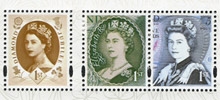
A display marking the Diamond Jubilee of Queen Elizabeth II
An insight into the making of the stamps released to mark the Diamond Jubilee - on display in our archives.
Stamp Design
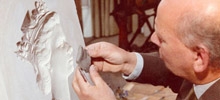
Ever wondered how British stamps are designed?
Read our overview of how topics for stamps are chosen, and how stamps are designed and approved for printing.
Timeless & Classic

An online exhibition looking at one of the most famous stamps in the world
Tracing the evolution of Arnold Machin's definitive stamp design from conception to international icon.


